
Project Goals
The goal of this project was to stretch my design skills and showcase my complete production workflow. For this project, I chose to design a cinematic experience reminiscent of titles like Uncharted and Tomb Raider. My level highlights several core pillars of the 3rd-person action-adventure genre:
Environmental Storytelling: Conveying history and narrative through layout and set dressing
Exploration & Mystery: Guiding players through uncharted, awe-inspiring yet dangerous spaces
High-Stakes Traversal: Crafting action-packed, death-defying platforming sequences
To achieve these goals, I analyzed genre benchmarks, drafted a comprehensive Level Design Document (LDD), and meticulously documented my blockout process. You can explore my full development pipeline below.
Iteration Highlight Overview
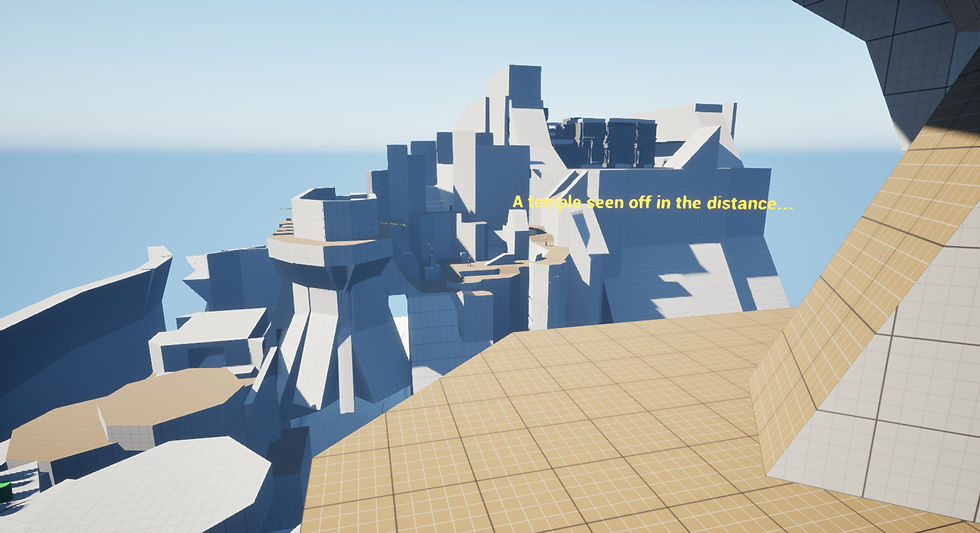
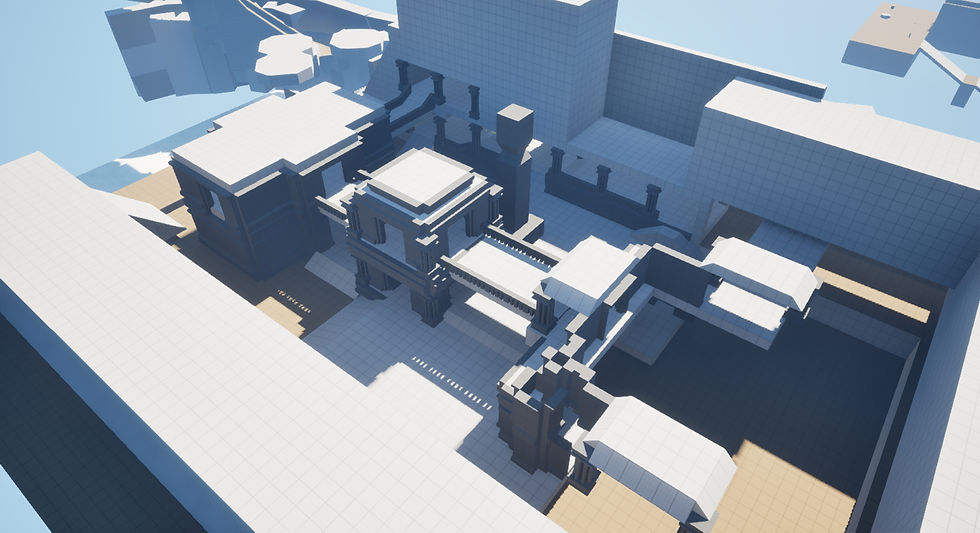
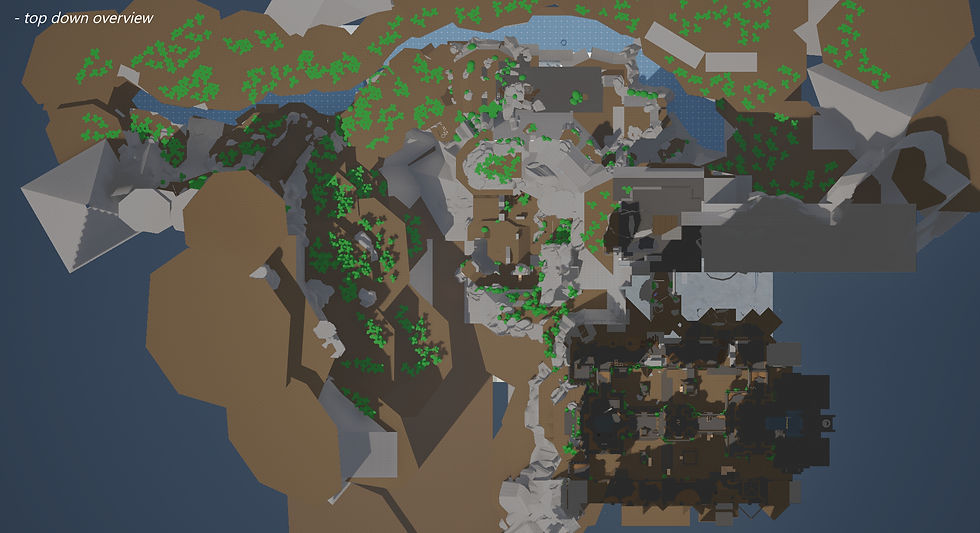
Once I brought in a draft of my top down map, I roughed out the size and shape of my level. The images here show the course of iterations of my level from start to finish.





Technique Highlight:
Guiding the player
If someone hands you a key and you spot a locked door behind them, you instantly connect the two. You don't need instructions; you instinctively approach the door and use the key. Relying on tension resolution loop, I use level layout, landmarks, and sightlines to invisibly guide the player:
The level begins with an ascending cliffside path, tapping into the natural player instinct that upward movement equals progress. Upon reaching the summit, a scripted camera pan reveals the distant temple ruins—instantly establishing a visual 'key and door' relationship. As the highest point of interest on the horizon, this temple serves as a permanent orientation landmark. From this vantage point, players also catch a subtle, foreshadowing glimpse of the winding path they will eventually traverse to reach their destination.
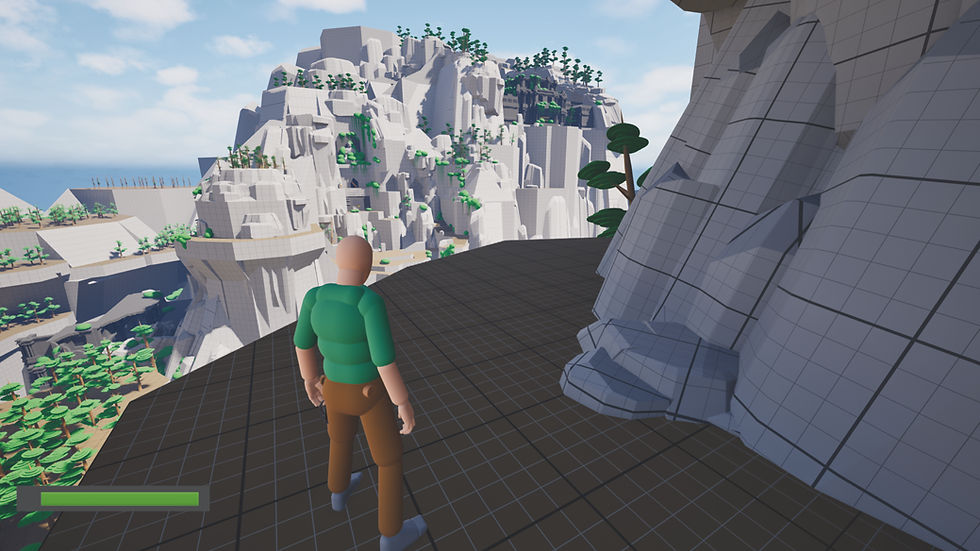


To mitigate disorientation after the cliffside collapse, I opened a sightline to the right that frames the temple as a visual anchor. This reorients the player before they are forced onto the narrow, descending detour to the left—using the descent to organically foreshadow a sense of danger and vulnerability.


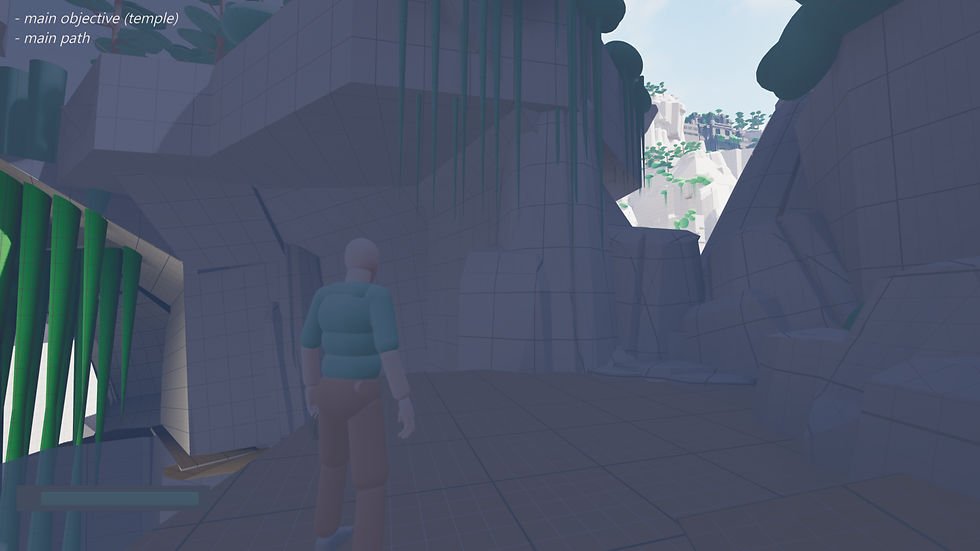


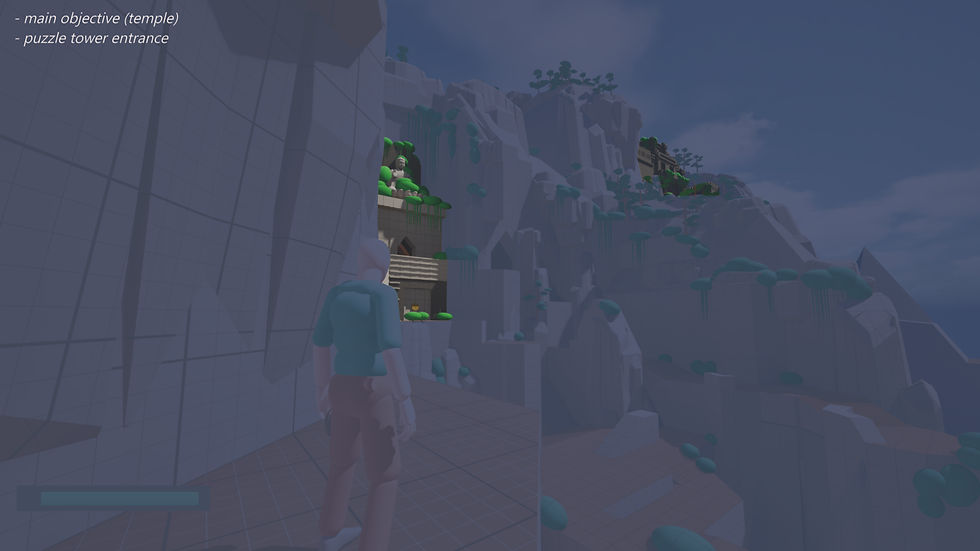
Rounding this cliff bend rewards players with a distant view of their starting area, a visual contrast that highlights how much ground they have covered and reinforces their sense of progression. As they continue along the cliffside, a second scripted camera pan reveals that the temple is now much closer, re-establishing their ultimate objective and driving them forward.
Technique Highlight:
Immersive gameplay design
Because player mechanics iterate constantly, finalizing tutorials late in production often risks breaking a level's pacing. My approach is to design with opportunistic layouts that preemptively allocate flexible zones for player onboarding. By treating these teaching moments as modular beats, I ensure they are woven organically into the setting but remain easily adjustable. This agile design structure allows me to relocate or entirely cut tutorial segments to match shifting gameplay metrics, without requiring costly, destructive redesigns of the main level flow.


To introduce the item collection mechanic early, I created a scenario where the player falls into the ravine and takes fall damage, establishing a direct mechanical need for recovery. I utilized a spatial opportunity to the right of the ruins, placing an abandoned campsite for the player to explore. Finding bandages here feels completely diegetic; it uses the environmental narrative to justify the tutorial, teaching the player how to scavenge and heal in a logical, low-stress environment.


To make the rope mechanic feel native to the setting, I carefully plan the environmental context of each anchor point—utilizing natural tree branches in outdoor sections and shifting to decorative ceiling ornaments in ruin interiors. The mechanic itself offers high player agency, requiring players to master both swinging across gaps and managing their vertical slack. Once this onboarding is complete, I combine the rope with other traversal elements to test player rhythm and manipulate the level's overall pacing.


To maximize player agency, the initial combat encounter begins unarmed, allowing players to stealth their way through the space. The pistol can be scavenged via stealth takedowns or found along the main path. Rather than interrupting pacing with a forced tutorial, I designed the subsequent beat as a mechanical gate: a platforming puzzle where players must shoot interactive targets to extend platforms, organically teaching them the shooting mechanic through gameplay.
Technique Highlight:
Traversal Design
Instead of using environmental hazards purely as obstacles, I integrated ancient traps into the level's puzzle-solving. By allowing players to manipulate or exploit these dangers to progress, they feel clever, capable, and highly resourceful.
To introduce traps cleanly, I placed a pressure plate right at the exit of a crawlspace. This acts as an immediate, low-risk tutorial. The environment is styled to keep the player safe initially—using a collapsed boulder to block the first spiked wall trap. This gives players a moment to analyze the threat before navigating through gaps in the remaining traps. Spotting a fractured floor in the distance, players are encouraged to sprint and slide into the opening to escape, rewarding quick spatial awareness and reaction times.


In this sequence, the structural housing of the wall traps is recontextualized as a traversal tool, requiring players to use the trap bars as temporary ledges to cross the cliff gap. Timing is critical as they navigate across these active hazards to reach a disabled, broken trap that serves as a makeshift platform. To inject a dynamic shift in pacing and reinforce prior mechanics, the sequence culminates in a high-stakes rope swing—challenging the player's reflexes and creating a memorable, multi-layered traversal experience.


Designed as a final skill verification beat, this interior tower puzzle layers all previously introduced mechanics into a single cohesive challenge. Players must shoot targets to deploy platforms, navigating them before their built-in retraction metrics force them back into the walls. The upward layout introduces systemic complexity by requiring players to combine this strict shooting-and-movement loop with precision rope swinging—shifting the pacing into a memorable, high-tension climax that rewards complete player mastery.
Beat Overview


Beat 1 - Locating the Temple


The introductory beat begins (1) as the player navigates a cliffside path in rural India. As they reach the vantage point at the edge (2), a framing shot establishes the temple ruins on the adjacent mountain. This visual anchor is immediately followed by a pacing shift: the unstable footing collapses, sending the character sliding and tumbling (3) into a deep ravine.
Beat 2 - The ravine


The player reorients themselves (1) by locating the distant temple on the horizon. They follow a natural waterway that the ravine has carved out over the years, navigating a narrow path (2) overgrown with dense foliage. As they carefully make their way forward, the tight corridor opens up to give the player a striking reveal (3) of undiscovered ruins.
Beat 3 - The ruins...


The ravine floor expands into a ruined courtyard, offering a diegetic exploration reward to the right: an abandoned camp (1) with health pickups. The critical path then forces the player into a moment of spatial compression as they crawl through dense rubble (2). Upon exiting, a pressure plate (3) trips an immediate wall trap hazard. To survive this sudden pacing transition, the player must utilize their spatial awareness to spot a cracked opening in the floor and make a break for it (4) to reach safety below.
Beat 4 - Scaling the cliffside


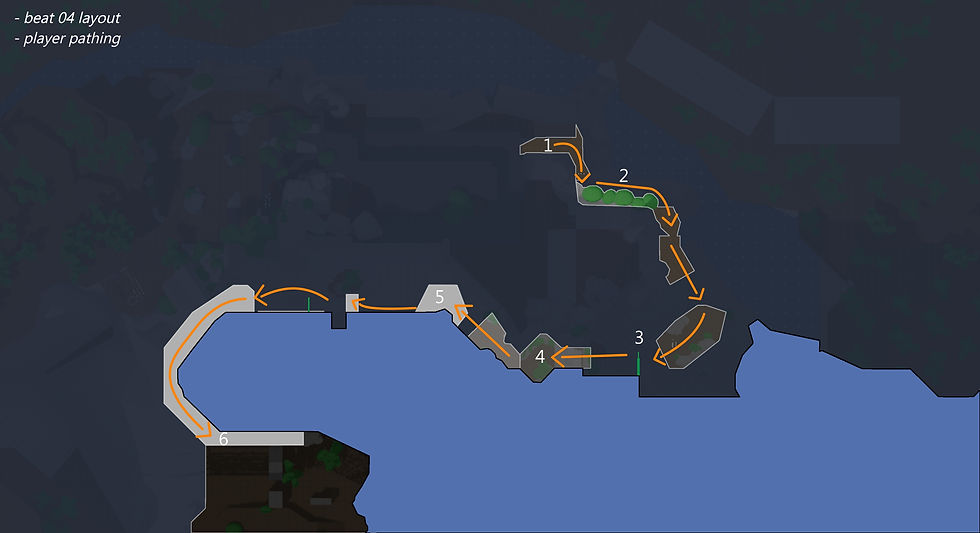
After escaping the subterranean ruins (1), the layout opens into a technical cliffside climb (2). The player faces a spatial challenge requiring a precision rope swing (3) to traverse a wide gap and reach an elevated ledge. Passing through a brief crawlspace, the pacing shifts to vertical navigation as they scale the cliff walls (4). At the summit, the player encounters a hazard subversion puzzle, requiring strict timing to utilize the active wall traps as climbing fixtures (5). Clearing this zone rewards the player with a visual checkpoint as the temple frames prominently in sight (6).
Beat 5 - Encountering mercenaries

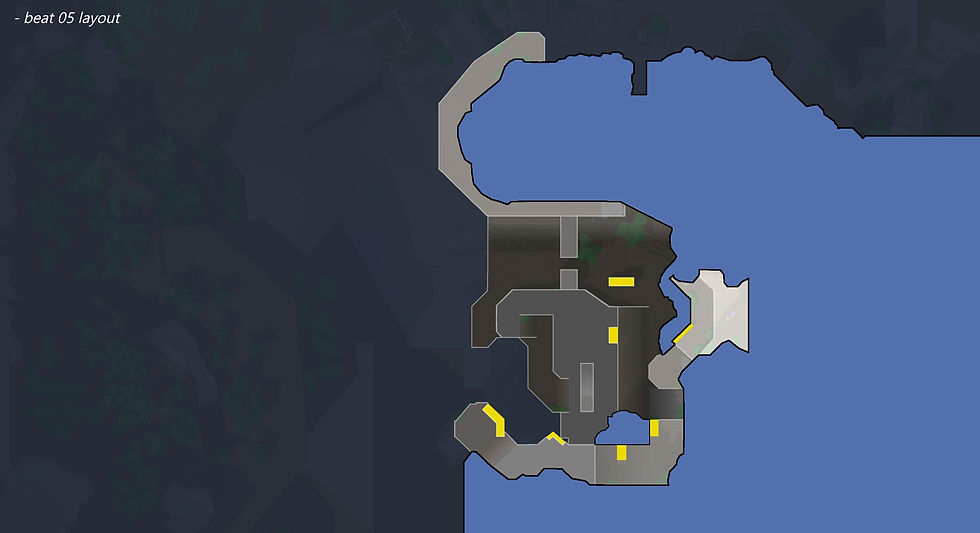

The player notices they are closing in on the temple, but the ground (1) beneath the cliffside gives way once more. The fall distance is shallow, but the noise alerts nearby mercenaries who descend into the valley. Trapped in the basin, the player must find a way out. They can choose to stealthily eliminate an isolated enemy (2) moving toward the center, or traverse up the cliff face (3) to secure a height advantage. If they haven't scavenged a firearm yet, one can be found along this path (4). Upon reaching a locked main door, climbing above the entrance structural elements (5) reveals a hidden alternative entryway.
Beat 6 - Climbing the Tower


The player lowers themselves via rope to reach the tower's bottom floor (1). Here, they engage with the core platforming tutorial, shooting targets to temporarily extend platforms. They navigate across the basin (2) to reach the base of the central structure. From here, they begin their vertical ascent (3) to reach the second floor. Navigating another set of interactive elements (4), they must execute a rapid rope swing across a chasm to grab onto a broken platform (5). Finally, they time their movements across the last set of retracting platforms to reach the tower's summit (6), where they climb to the highest point, swing outside to scavenge a rifle from a fallen mercenary, and enter a tight squeezeway.
Beat 7 - Temple Finale
The level culminates as the player enters the core temple complex, featuring impressive architectural scale with three massive structures interconnected by high-altitude bridges (1). Dense crate layouts throughout the space serve as combat cover while reinforcing environmental storytelling regarding the mercenaries' looting operations. Reaching the central altar, the player interacts with a hidden mechanism (2). This triggers a secret passage sweep (3), providing a high-impact narrative payoff that transitions the player into the next chapter.


